
Pathways
Pathways
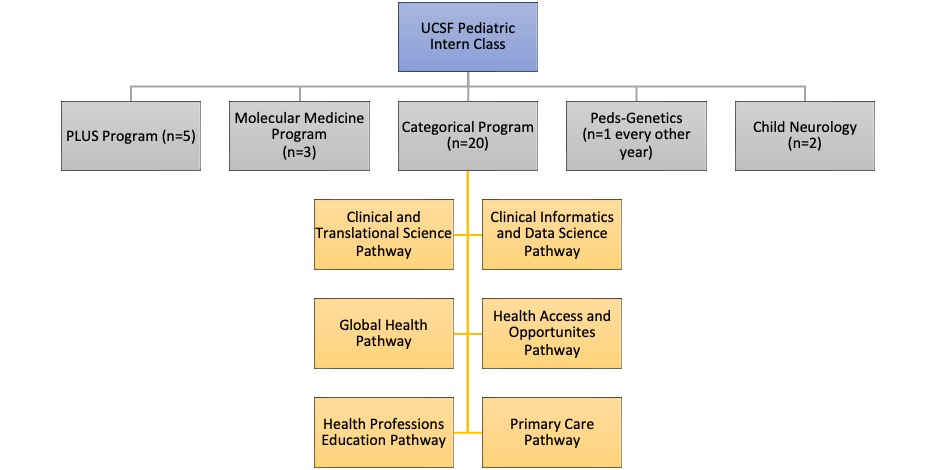
Residents in the Categorical Program have the option of applying to participate in one of our interest-specific Pathways. Pathways provide a way for residents to build on their individual interests and passions and/or explore new interests. The central feature of most Pathways is an expectation to complete coursework and a mentored longitudinal project (for which we provide protected time during call-free blocks).
After the match, all residents matching into the Categorical Program have the option, but are not required to, apply to one of several tracks. The majority of these take place in the 2nd and 3rd year of residency, though there are opportunities in some for some early exposure and connection to understand offerings and alignment with career goals.
About halfway through the first year of training, residents have the option of applying to participate in one of our Pathways, most of which are GME-wide (the exception is Primary Care). The purpose of a Pathway is to allow residents to develop a specific set of skills that could be useful across a broad range of clinical areas and to pursue mentorship and scholarship – defined broadly – as a part of that Pathway.
Each Pathway has a lead; the ones with asterisks have Pediatric-specific leads
- Clinical & Translational Science*
- Clinical Informatics and Data Science
- Global Health*
- Health Access and Opportunities
- Health Professions Education
- Primary Care*
- This pathway is specific for Pediatrics and gives residents enhanced training in Pediatric Primary Care including didactic sessions, a longitudinal project and extra outpatient clinical experiences as a part of their elective time.
Clinical Informatics and Data Science Pathway
The Clinical Informatics and Data Science (CI-DS) Pathway provides an opportunity for participants to learn basic concepts, principles, and skills in these fields and serves as a resource to explore potential careers in these areas.
Clinical and Translational Science Pathway
The Clinical and Translational Science Pathway builds resident skills in clinical research design and biostatistics. This is a great option for residents considering a career in clinical research. This pathway builds on the pediatrics department’s strong relationship with the Clinical and Translational Science Institute at UCSF and includes formal coursework in research design as well as a cohort-based mentoring program and mentored longitudinal project.
Global Health Pathway
The Global Health Pathway seeks applicants with a specific commitment to global health. Future plans may include clinical work, research, and program or policy development relating to global health. Participants obtain clinical experience in a resource-limited country, join a local community of like-minded faculty and trainees from a variety of specialties and disciplines, participate in a didactic curriculum specifically addressing issues of global health, and complete a mentored scholarly project relating to global health.
Health Professions Education Pathway
The Health Professions Education Pathway aims to prepare residents for a career in medical education. It is integrated with the Health Professions Pathways to Discovery program in the UCSF School of Medicine. Residents complete formal coursework in medical education and curricular design, as well as complete a mentored scholarly project.
Health Access and Opportunities Pathway
The Health Access and Opportunities Pathway engages learners in conversations, skill building, and reflection around improving health access outcomes for all populations, promoting equity in the medical workforce, and actively promoting inclusion and addressing barriers to access. Learners will explore issues of identity, privilege, and bias through discussion, experiential learning, community engagement, and critical self-reflection.
Primary Care Pathway
Primary Care Pathway residents are trained in clinic and community-based approaches to child health. A growing model in pediatrics is the bridging of primary care with community health. Throughout their training, residents are exposed to multiple facets of primary care through seminars, resident meetings, and individually-tailored call-free elective blocks in each year of residency. During their primary care blocks, residents have time dedicated to community engagement and/or primary care research projects as well as primary care-related subspecialty experiences.